
The cleanest regulatory profile in offshore turbine cleaning
No substances of very high concern. No persistent organic pollutants. No endocrine disruptors. Hazard and transport position stated in full.
Formulated for the spaces where your people work
The interior of a wind turbine nacelle has been compared to a submarine — sealed, cramped, poorly ventilated. Technicians work in these conditions for hours at a time, surrounded by electrical and hydraulic systems.
TurbineClean is water-based, not solvent-based. It has a barely perceptible odour. It is non-flammable. For technicians, it means working in confined spaces without respiratory assault. For HSE managers, one major hazard category reduced.
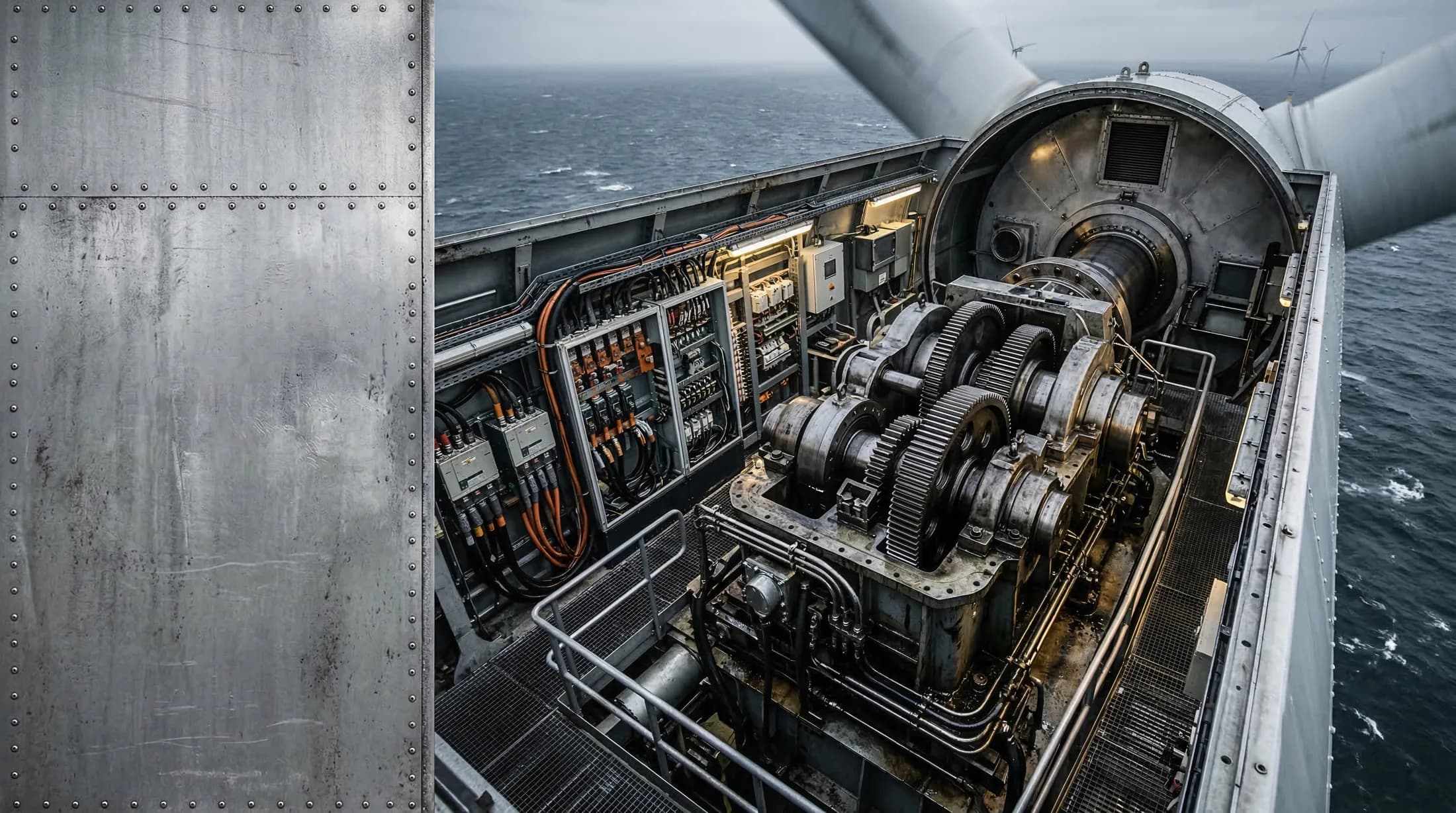
Confined space cleaning inside wind turbines
Cleaning inside a wind turbine is confined space work. Nacelles and towers are sealed, cramped and poorly ventilated, with electrical and hydraulic systems close at hand. Whatever product goes in has to hold up in a COSHH assessment before a technician ever opens the container.
TurbineClean is built for that setting. It is water-based, low-odour, and not classified as flammable, with a flash point above 65 °C, so it does not flood a confined space with volatile fumes the way brake cleaner and petroleum solvents do. That is what a COSHH compliant cleaning product for offshore wind looks like in practice: the exposure and flammability risks come down, and the assessment gets easier to defend. See how it supports HSE managers.
Readily biodegradable. No substances of concern.
The formulated mixture is classified as readily biodegradable with no bioaccumulation potential — verified against the most stringent substance lists.
The concentrate ships as dangerous goods. Here is exactly what that means.
We would rather you heard this from us than found it on the paperwork. As supplied, the concentrate is classified UN 1760, Corrosive liquid n.o.s., Class 8, Packing Group II, and is a marine pollutant under IMDG. It is regulated under ADR, IMDG, IATA, ADN and RID, and the limited quantity threshold is 1 litre.
In practice that means it travels with a carrier approved for dangerous goods rather than a standard parcel service, and delivery is quoted with your order. It also means your team handles a corrosive concentrate at the point of mixing, which belongs in the COSHH assessment and the method statement.
Once diluted at 1 part to 5 parts clean water, the working solution your technicians carry up the tower is a far milder proposition than the concentrate in the container. Ask us for the current Safety Data Sheet before you build any of this into a method statement.
Designed to pass your approval process, not complicate it
Everything an assessor needs is stated rather than buried. The composition, the hazard classification, the transport position and the environmental profile are all published, including the parts that are inconvenient for us.
We are developing a ready-made COSHH assessment data pack that HSE managers can adopt directly, reducing time and effort to move from evaluation to approval.
A note on the H412 classification
H412: “Harmful to aquatic life with long lasting effects”
At concentrate strength only
We address this directly because transparency builds trust. H412 is the mildest aquatic hazard category under the CLP Regulation. At use-dilution, the environmental profile improves significantly.
In practice, TurbineClean is applied to internal surfaces, wiped or absorbed, and contained within the turbine structure.
Need the full data for your assessment?
Request the Safety Data Sheet, COSHH data pack, and environmental compliance summary.